
When Carbon Hit the Dirt
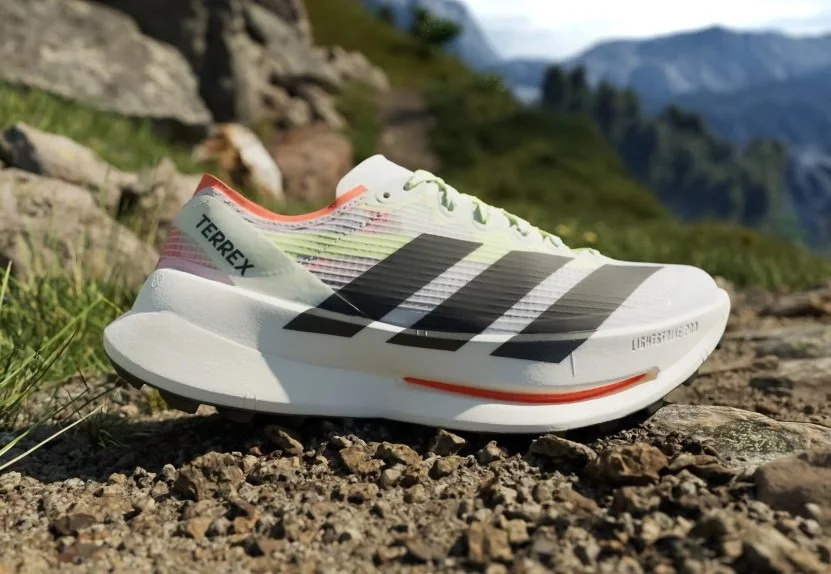
For years, carbon plates belonged to the road — sharp, stiff slabs of propulsion reserved for marathon PRs and smooth tarmac. Trails were different. They were supposed to be wild, unpredictable, too uneven for anything stiff or engineered. But somewhere between Western States podiums and alpine ultras, something changed.
Carbon finally found its way to the mountains.
And last year at UTMB Salzburg, I ended up stepping into the trend myself when I laced up a pair of Adidas Terrex Agravic Speed Ultra shoes — a model shaped by the same wave of innovation that’s turning trail running into a testing ground for speed‑focused technology.
The Carbon Arrival: How It Started
The shift didn't happen quietly. Nearly every major trail brand spent the past two years developing plated trail “supershoes,” a trend confirmed at The Running Event where almost every big brand announced or showcased a plated trail racer for the 2026 season.
Adidas played a major role in this turning point. Their Terrex team launched the Agravic Speed Ultra, a carbon‑enhanced trail shoe with EnergyRods and Lightstrike Pro foam — a combination that helped athletes like Ruth Croft win UTMB races and cement the shoe’s elite credibility.
Other brands followed:
ASICS brought plated prototypes that dominated men’s podiums at UTMB. [outdoorsmagic.com]
HOKA refined the Rocket X Trail — high stack, aggressive rocker, carbon plate. [roadtrailrun.com]
The North Face pushed dual‑plate designs in their Vectiv Pro line. [marathonhandbook.com]
What started as a few experimental models has become a full-scale movement: trail running now has supershoes of its own.
Why Carbon Matters on the Trails
For a long time, runners doubted whether carbon plates made sense off‑road. The thinking was simple: plates are stiff, trails are chaotic. But foam has evolved, geometry has evolved, and trail design itself has evolved.
Carbon now brings:
More efficient climbing by stabilizing the forefoot on uphill drives.
Faster rolling descents thanks to aggressive rocker profiles.
Energy preservation over long ultras — critical when races stretch into double-digit hours.
Enhanced responsiveness on smooth sections, which increasingly define modern ultra courses.
This evolution shows up in the specs. The updated Agravic Speed Ultra 2, for example, uses softer Lightstrike Pro foam, trail‑specific EnergyRods, and a revamped upper — all pushing toward greater comfort and speed over long distances. [news.adidas.com]
Trail running isn’t resisting carbon anymore. It’s absorbing it, shaping it, and using it to move faster through mountains.
My Own Shift: UTMB Salzburg and the Terrex Agravic
When I laced up my adidas Terrex Agravic Speed Ultra for UTMB Salzburg last year, I wasn’t chasing a podium — but I was curious.
I wanted to know what carbon would feel like in the Alps.
Would it stumble on rocky sections?
Would it feel too unstable?
Or would it unlock something new?
Within the first climbs, I had my answer.
The shoe didn’t feel stiff — it felt direct.
EnergyRods flexed just enough to match the terrain, giving that rolling forward pull without fighting my foot. The Lightstrike Pro midsole didn’t sink or squish; it rebounded.
On runnable sections, the shoe came alive. It felt like that perfect meeting point where road geometry meets mountain grit — a sensation that products like the Speed Ultra were specifically designed to deliver.
But the surprise wasn’t the speed.
It was the effortlessness.
Hours into the race, my legs still felt awake enough to push.
A Trend Now Too Big to Ignore
All signs point in one direction: carbon plates are here to stay in trail running.
Brands are investing across entire lineups. Adidas Terrex alone refreshed four models for 2026, including the plated Agravic Speed Ultra 2 and a more technical plated option, the Agravic TT. [gearpatrol.com]
Race results back up the technology — podium after podium wearing plated prototypes or production supershoes. [outdoorsmagic.com]
Gear analysts now refer to 2025 as a “banner year for trail super shoes,” with 2026 models pushing even further. [roadtrailrun.com]
The debate is no longer if carbon belongs on trails.
It’s how fast the evolution will reshape the sport.
The Trail Future Is Carbon‑Lined
From UTMB to local ultras, from Chamonix to Salzburg, carbon plates have rewritten what trail shoes can do. They’re not replacing traditional models — but they’re redefining the top end of performance.
For me, the shift isn’t theoretical.
It lives in that memory of flowing through the Salzburg trails with a feeling of unexpected ease, powered by a plate and foam designed not just for roads, but for ridgelines, climbs, and alpine air.
The mountains haven’t changed.
But the way we move through them has —
and carbon has something to do with that.
